
K-12 Weekly STEM Programmes (4 - 16 Years)
K-12 Weekly STEM Programmes (4 - 16 Years)

Junior STEMERS Programme
For ages: 4 to 6 Our Junior STEMERS programme aims to introduce the fundamentals of computational thinking and STEM activities through robotics kits to young children. They will be exposed to different types of coding and robotics, such as Matatalab...

Chinese Enrichment Programme 华文乐乐班
For ages: 4 to 9 Unlock the magic of coding and robotics as your child discovers the fascinating world of the Chinese language! Designed for kids aged 4-9, the Chinese Enrichment Programme (华文乐乐班) offers a one-of-a-kind experience that combines innovative...

Lego Robotics DSA Programme – National Robotics Competition (NRC)
For ages: 7 and above The workshop will equip participants with the necessary skills and knowledge to design, build, and program robots for the National Robotics Competition (NRC) 2024, organised by Science Centre Singapore. https://www.science.edu.sg/for-schools/competitions/national-robotics-competition Topics covered are: Introduction to...
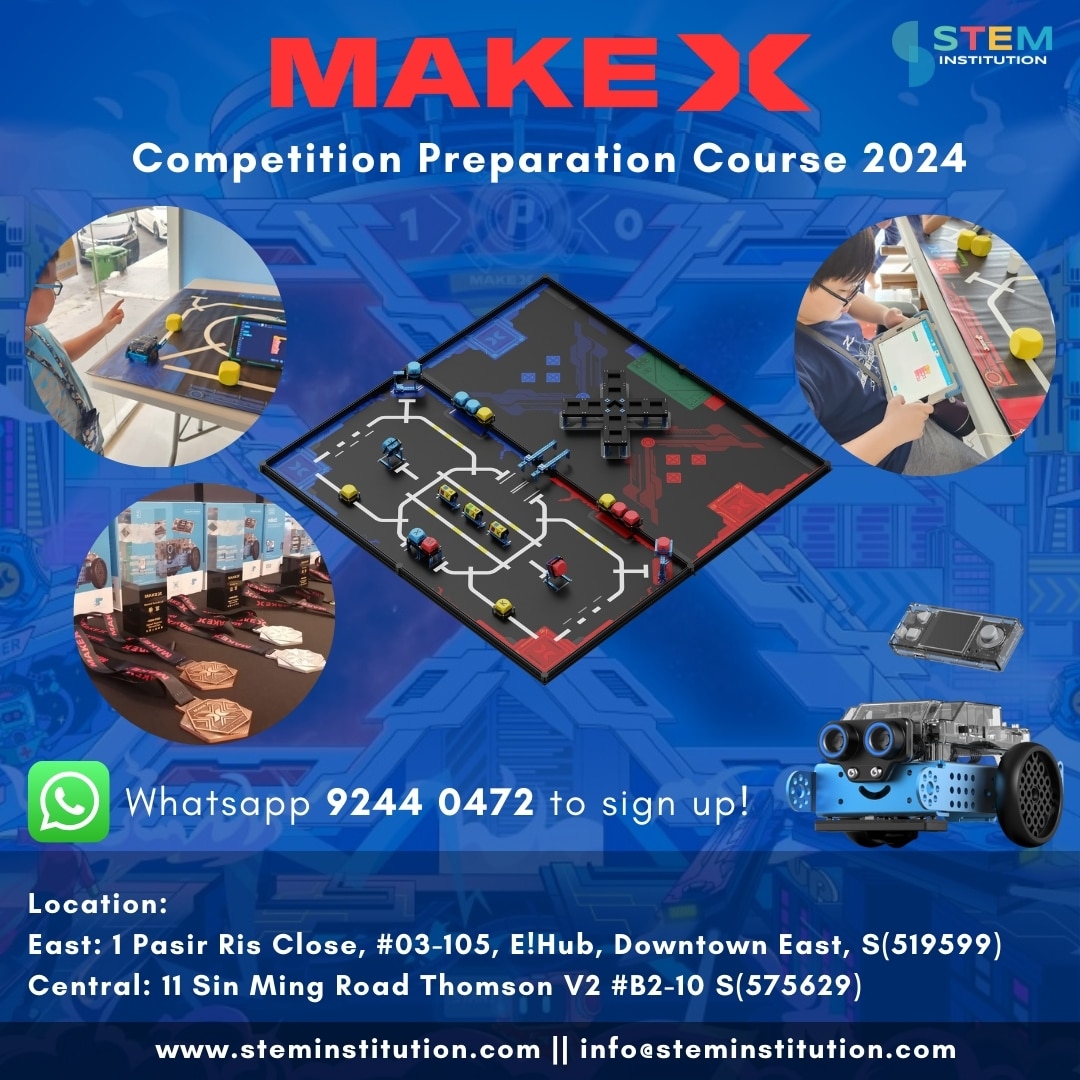
Robotics mBot2 Training Programme 2024
For Ages: 9 to 14 years old Objective: This 24-hour MakeX workshop aims to introduce participants to innovative design, problem-solving, and prototyping. It seeks to provide a comprehensive understanding of the product development process, empowering attendees with the necessary skills...

Scratch Coding Programme (IDE Code Builder Competition)
For Ages: 7 to 12 In this programme, students get to learn the concepts of programming using Scratch 3.0, a block–based coding platform. Students will learn standard programming while focusing on increasingly challenging computational thinking activities. Students will learn standard...

Lego Robotics Programme (DSA) – Spike Essentials
For ages: 6 to 8 In this programme, children will engage in a mix of hands-on and screen learning. Students will learn to problem-solve and come up with solutions through story-telling and computational thinking using the Lego Robotics Spike Essentials...

Learn from Home Series: mBlock5 and CyberPi Go
For ages: 9 and above In this online live course, learners will learn how to program, connect and control a microcontroller with block-based programming software to develop STEM projects using sensors with a dedicated teacher throughout ten (10) weekly sessions....





FAQs
What do the K-12 Weekly STEM Programmes cover?
K-12 STEM Programmes encompass a wide range of science, technology, engineering, and mathematics disciplines. Our K-12 Weekly STEM programmes are split into coding and robotics, and are designed to introduce the students to the various types of coding and robotics that they can learn, as well as important ideas and capabilities in STEM.
Each weekly programme will make use of a relevant software and programming that allows students to operate the corresponding robotic kit. Students will learn the fundamentals of coding and design programmes with visual codes. They will make use of computational and design thinking to identify and resolve real world problems.
Our K-12 Weekly STEM Programmes incorporate hands-on activities and other interactive components aimed to engage and inspire students that may motivate them to pursue further study or profession in these sectors.
What are the benefits of joining K-12 Weekly STEM Programmes?
Participating in our K-12 Weekly STEM Programmes may provide students with several benefits, including:
1) Exposure to STEM: Students may explore and discover their interests and passions in many areas of science, technology, engineering, and mathematics, as well as gain numerous hard and soft skills in these areas.
2) Future career prospects: STEM fields are currently in great demand, so students who enroll in STEM programmes may earn crucial skills and information that will help them in their future careers.
3) Fun and hands-on learning experience: STEM programmes frequently include hands-on activities, experiments, and projects, which may help students learn by doing, gain a better understanding of scientific principles, and develop a passion of learning.
These activities can also help children develop confidence in themselves, passion in studying, as well as an understanding of the relevance of science and technology in their daily lives.
What are skills that can be gained from K-12 Weekly STEM Programmes?
Our K-12 Weekly STEM Programmes will help students acquire a range of vital hard and soft skills. Here are some examples:
1) Problem-solving: Students will learn how to think critically, examine facts logically, and solve complicated tasks and issues presented in the program.
2) Technical skills: Student will learn hard, technical skills such as coding, robotics, data analysis, and design.
3) Collaboration: Our STEM programmes emphasize cooperation and teamwork, so students may learn how to communicate effectively, collaborate with others, and share ideas.
4) Creativity: Our STEM programmes emphasize on innovation, pushing students to explore fresh and novel ideas and solutions to real-world challenges.
Overall, our K-12 Weekly STEM Programmes may assist children in developing a variety of skills that will benefit them both academically and professionally.
Who are K-12 Weekly STEM Programmes suitable for?
Our K-12 Weekly STEM Programmes are appropriate for a wide range of students from Kindergarten to Grade 12. We have age-appropriate programs for students ages 4 and up to 12 and above, with each program designed for pupils from specific age groups so they can work, learn, and play together with their peers. Each programmes' structure and learning points are also arranged according to the specific learning goals in each age groups.
Our K-12 Weekly STEM Programmes are ideal for students who have a strong interest in STEM and want to learn more about them, and is also suitable for students who have not previously explored STEM disciplines but want to discover new interests and prospects. Overall, our K-12 Weekly STEM Programmes are appropriate for a wide variety of pupils of all ages and ability levels.
What does a typical K-12 Weekly STEM Programme look like?
A K-12 Weekly STEM Programme can take a variety of forms based on the specific programs, age groups, and goals. However, here is an example of what our K-12 Weekly STEM Programme might look like:
Each lesson usually starts with an introduction to the day's topic, objectives, and background information on the STEM principles that will be covered. Following that, the program will include hands-on activities and experiments involving the use of technology to execute tasks such as developing and programming robots or performing scientific investigations. At the end of each lesson, students may reflect on what they have learnt and share their thoughts and comments with the class. Lastly, students may be assigned homework or additional assignments to accomplish between classes, such as more experiments or study on the subject.
